
Renting the largest bin available for your concrete or dirt project is often the most expensive mistake you can make. While a 20-yard container looks spacious, filling it with dense materials like brick or asphalt will quickly exceed legal road weights. Finding the right dumpster for heavy debris is about weight capacity, not just volume. If you get it wrong, you end up with a bin that’s too heavy for the truck to lift and a massive bill for overweight fees.
We understand that you want a straightforward, flat-rate solution that gets the job done without the logistical headaches. You shouldn't have to guess if your driveway can handle the load or if the driver will leave the bin behind on pickup day. Managing heavy waste requires a "small bin, high density" strategy to ensure safety, protect your property, and maintain price transparency.
In this guide, you'll learn how to manage heavy waste safely and affordably. We'll explain why our 10-yard bin is the "Heavy Debris Hero," detail the specific loading rules you need to follow for dense materials, and show you how to guarantee a successful pickup every time without hitting hidden weight limits.
Key Takeaways
- Identify high-density materials like concrete, brick, and dirt that require specific disposal strategies to avoid surcharges.
- Learn why a 10-yard dumpster for heavy debris is the industry standard for preventing truck lift failures and road weight violations.
- Master the "2-ton rule" to accurately estimate your load weight and eliminate the anxiety of hidden overweight fees.
- Discover proper loading techniques that protect your driveway from damage and ensure a seamless, issue-free pickup.
- Understand how local Clarksville flat-rate pricing and same-day delivery options streamline your heavy-duty demolition project.
What Qualifies as Heavy Debris for a Dumpster Rental?
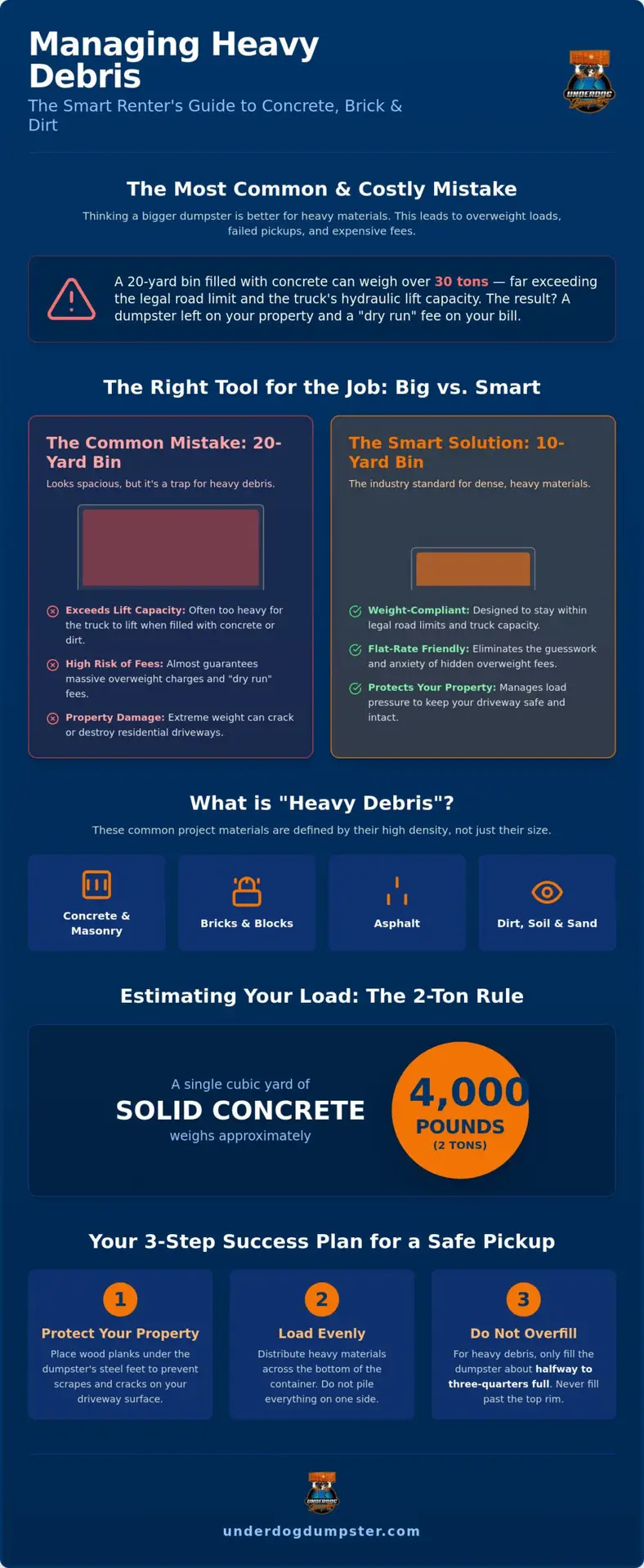
Heavy debris is defined by its density rather than its physical size. While a standard roll-off might hold several tons of household junk without reaching a limit, materials like concrete or brick reach the truck's hydraulic lift capacity long before the container looks full. Choosing the right dumpster for heavy debris is essential because these materials are incredibly compact. A single cubic yard of solid concrete weighs about 4,000 pounds. If you fill a large 25-yard bin to the top with this material, the truck simply won't be able to lift it from your property.
The most common types of heavy debris include:
- Concrete (with or without rebar)
- Brick and masonry blocks
- Asphalt from driveway removals
- Clean dirt, soil, and sand
- Roofing shingles and aggregate underlayment
Landfills and recycling centers treat these materials differently because they are "inert." They don't decompose or release toxic gases as they sit in the ground. Because they can often be crushed and reused for road bases or new construction, keeping them separate from general waste is a logistical priority. This special handling requires specific transport protocols to ensure the truck remains within legal road weight limits during transit.
Inert Waste vs. Mixed Construction Debris
Inert waste includes materials that stay chemically stable over time. Concrete, stone, and dirt fall into this category. If you keep your load "clean" by only disposing of one type of material, you can often secure more predictable rates. However, mixing heavy debris with household trash or treated wood changes the classification. This leads to higher tipping fees at the landfill because the load can no longer be recycled easily. Always confirm your waste type before booking to ensure your flat-rate price stays locked in.
Common Heavy Debris Projects in Clarksville
Local property owners often face these heavy lifting tasks. We see frequent driveway and sidewalk demolition projects in Sango neighborhoods where old concrete needs a fast exit. Local contractors also rely on us for retaining wall repairs and masonry work throughout Montgomery County. For those tackling full roof replacements, utilizing a specialized dumpster for roofing shingles Clarksville service ensures the weight of the aggregate doesn't cause a pickup delay. Whether you are clearing a lot or tearing out a patio, a dedicated dumpster for heavy debris keeps your site organized and your budget on track.
The 10-Yard Rule: Why Smaller is Better for Heavy Loads
When you're staring at a massive pile of broken concrete, your first instinct might be to rent the largest container available. This is a common mistake that leads to project delays and unexpected costs. For dense materials, bigger is rarely better. Most roll-off trucks have a specific hydraulic lift capacity and legal weight limit for transport. If you fill a 20-yard or 25-yard bin with solid concrete, the weight can easily exceed 30 tons. This is far beyond what a standard truck can safely winch onto its bed, and it often exceeds legal road weight limits set by the Department of Transportation.
A 10-yard container is the industry standard for a dumpster for heavy debris. It provides enough volume to handle significant demolition work while keeping the total weight within a manageable range. Using a smaller bin protects your property. A 20-yard bin filled with brick or dirt exerts extreme pressure on a residential driveway, often leading to deep cracks or structural failure. Our 10-yard "Heavy Debris Hero" offers the perfect balance of volume and safety, ensuring your project stays on schedule and your driveway remains intact.
Understanding Weight Limits and DOT Regulations
Safety isn't just about the truck; it's about the law. Department of Transportation (DOT) regulations strictly govern how much weight a single axle or vehicle can carry on public roads. If a bin is overloaded, the driver cannot legally pick it up. This results in a "dry run" fee, where you're charged for the trip even though the bin stays on-site. You'll then have to manually remove material until the weight is legal. To avoid this, always follow safe loading practices and pay close attention to fill lines. For heavy materials, these lines are often much lower than the top rim of the container.
When to Step Up to a 15 or 20-Yard Bin
While the 10-yard bin is king for pure concrete, some projects involve a mix of materials. If you're doing a full home renovation that includes both heavy masonry and lighter bulky items like drywall or wood, a 15-yard dumpster might be the better choice. Roofing shingles are another exception. While they are heavy, they take up more space than solid concrete blocks, often requiring a slightly larger bin to hold the entire tear-off. If you're unsure which size fits your specific material, reach out to our local team for a quick recommendation based on your project scope.
Estimating Weight to Avoid Overweight Fees
Accurately estimating the weight of your project is the only way to stay within your budget. Choosing the right dumpster for heavy debris starts with math, not a guess. Solid concrete is predictable; it weighs roughly 4,000 pounds, or 2 tons, per cubic yard. If you're tearing up a standard sidewalk, that weight adds up fast. Roofing projects follow different rules. One "square" (100 square feet) of three-tab shingles weighs approximately 250 pounds. Knowing these benchmarks prevents the sticker shock of a heavy-weight penalty at the scale.
Dirt and soil are the ultimate wildcards in debris management. Their weight fluctuates significantly based on moisture content. A dry yard of topsoil is heavy enough, but a rain-soaked pile can easily double in weight. Most trucks in Montgomery County face strict road limits that vary by season and route. Even if a 10-yard bin can physically hold 10 tons of material, the truck must still be able to transport it legally and safely. Following federal guidelines for avoiding overweight fees ensures your project remains compliant and cost-effective.
Calculating Your Debris Load
To find your total cubic yardage, use a simple formula: multiply the length, width, and thickness of your material in feet, then divide that total by 27. For example, a 10-foot by 10-foot patio that is 4 inches thick equals about 1.25 cubic yards. However, you must factor in "fluff." Broken concrete takes up about 30% more space than a solid slab because of the air gaps between the chunks. Dirt requires even more caution. One cubic yard of dirt equals roughly 1.1 to 1.5 tons depending on wetness. Always leave a buffer in your estimates to account for these variations.
The Benefit of Flat-Rate Pricing
National haulers often lure customers in with low initial quotes, only to add "price per ton" fees after the bin is weighed. This creates massive budget uncertainty. We believe in transparency. Our dumpster rental prices in Clarksville TN utilize a flat-rate model to simplify your planning. You'll know exactly what's included in your fee before the bin arrives. This approach removes the anxiety of guessing weights and protects you from the hidden surcharges common with call-center brokers. When you book a dumpster for heavy debris locally, you get clear terms and dependable service tailored to Clarksville's specific disposal regulations.
How to Load a Dumpster for Heavy Debris Safely
Loading a dumpster for heavy debris requires more than just muscle. It requires a specific strategy to ensure the truck can safely winch the bin onto its bed. When the driver arrives for pickup, the container is pulled up at a steep angle. If the weight isn't distributed correctly, the load can shift violently. This puts extreme stress on the truck's hydraulics and can even cause the front wheels of the vehicle to lift off the ground. A balanced load is the best way to prevent property damage and ensure a successful pickup on the first try.
Safety is the top priority during this process. You should never load materials above the top rim of the container. Loose concrete or bricks can fall out during transit, creating a major hazard for other drivers on the road. Instead of tossing heavy items over the side walls, utilize the rear walk-in door. This allows you to place items precisely rather than letting them crash into a random pile. It's safer for your back and better for the equipment.
Step-by-Step Loading Protocol
Follow these steps to keep your project site organized and safe:
- 1. Use the swing door: Open the rear door and walk your heaviest items directly into the bin. Start at the front end, which is the side closest to the truck's cab.
- 2. Distribute weight evenly: Spread the material across the entire floor of the dumpster. Don't let all the weight settle in one corner or at the very back.
- 3. Break down large slabs: Use a sledgehammer to break up large concrete pieces. This minimizes "bridging," which is when large chunks create massive air pockets that waste valuable space.
- 4. Keep the load level: Do not create a "mountain" in the center of the bin. A flat, level load is much easier to tarp and transport legally.
Protecting Your Property
The sheer weight of a loaded dumpster for heavy debris can be tough on asphalt or concrete driveways. We recommend placing street pads or large wood planks under the bin's rollers to distribute the pressure. This simple step prevents the metal from sinking into the surface or leaving permanent marks. You should also ensure the path for the truck's stabilizers is clear and level before the driver arrives. For a full list of site safety tips, review our construction site waste management checklist. If you have questions about your specific site layout, contact our local team to discuss the best placement for your project.
Booking Your Heavy Debris Rental in Clarksville
National haulers often rely on call centers that don't understand Clarksville's local terrain or specific landfill rules. When you need a dumpster for heavy debris, you need a partner who knows the difference between a residential street in Sango and a commercial site near Wilma Rudolph Blvd. We provide direct local support to ensure your heavy load is handled correctly from drop-off to final haul. Our team understands Montgomery County waste regulations, helping you avoid the permit delays or site violations that often plague national brokers who are unfamiliar with local "right-of-way" requirements.
Booking a dumpster for heavy debris shouldn't be a day-long chore. While national competitors force you through long phone queues just to get a quote, we offer a 2-minute online booking process at underdogdumpster.com. You can secure your bin for a weekend project or a major demolition with just a few clicks. We prioritize your schedule, offering same-day or next-day delivery options to ensure your project never grinds to a halt. Before the truck arrives, make sure your drop-off point is clear of vehicles and overhead obstructions like low-hanging branches or power lines.
The Underdog Advantage for Contractors
Time is money on a professional job site. We provide reliable swaps and hauls to ensure your crew never stands around waiting for an empty bin. Our flat-rate billing simplifies your bookkeeping by providing clear, upfront costs for client invoicing. There are no hidden fees to explain to your customers later. As a dedicated commercial roll off dumpster Clarksville partner, we understand the logistical demands of heavy demolition. We show up on time and place the bin exactly where you need it to maximize site efficiency.
Ready to Clear the Debris?
The 10-yard bin remains the smartest choice for concrete, dirt, and brick disposal. It keeps your weight manageable, protects your property, and ensures a successful pickup every time. Before our driver pulls onto your site, double-check that you have a clear, level path and your wood planks are ready for driveway protection. Underdog serves all of Montgomery County with reliable local service that national call centers simply can't match. Our "Heavy Debris Hero" is ready to help you finish your project without the stress of weight limits or hidden fees. Visit our booking page now to schedule your delivery and get that heavy waste off your property for good.
Start Your Heavy Debris Project with Confidence
Managing concrete, brick, and dirt doesn't have to be a logistical nightmare. By sticking to the 10-yard rule and distributing your load evenly across the bin, you protect your property and ensure a seamless pickup every time. You now have the knowledge to estimate your waste weight accurately and avoid the common pitfalls of overweight penalties and driveway damage. Choosing a specialized dumpster for heavy debris is the most important step in keeping your site organized and your budget on track.
As a locally owned and operated provider in Clarksville, we're dedicated to helping you skip the frustration of national call centers. Our transparent, flat-rate pricing ensures you won't deal with hidden weight fees or surprise surcharges after the job is done. We value your time; which is why same-day delivery is available to keep your momentum going. Let's get that heavy waste cleared so you can focus on the next phase of your renovation or construction project.
Rent Your 10-Yard Heavy Debris Dumpster Online Now
Frequently Asked Questions
Can I put concrete and dirt in the same dumpster?
Yes, you can mix concrete and dirt, but it changes how the landfill processes the waste. Mixing these materials often prevents the load from being recycled as "clean" fill, which can sometimes result in different tipping fees. Always inform your provider if you plan to mix various types of heavy debris. This ensures your flat-rate agreement covers the specific combination of materials you're disposing of during your project.
How much concrete can I put in a 10-yard dumpster?
You should only fill a 10-yard bin about halfway to two-thirds full when disposing of solid concrete. Because concrete weighs approximately 4,000 pounds per cubic yard, a completely full bin would weigh 20 tons. Most roll-off trucks have a maximum lift capacity of around 10 tons. Keeping the level low ensures the truck can safely winch the dumpster for heavy debris onto the bed without equipment failure.
What happens if my dumpster is too heavy for the truck?
The driver will be unable to lift the container, and you'll be charged a "dry run" fee for the attempted pickup. You will then have to manually remove enough material to bring the weight down to a legal and safe limit. Once the load is lightened, you must schedule a second pickup date. This process causes significant project delays and adds unnecessary labor and service costs to your budget.
Do I need a permit for a heavy debris dumpster in Clarksville?
A permit is only required if you place the dumpster on public property, such as a city street or right-of-way. In Clarksville, these permits are handled through the City's Citizen Self Service Portal and typically cost between $10 and $100. If the dumpster stays entirely on your private driveway, no city permit is necessary. However, you should always check with your HOA for any local neighborhood restrictions regarding bin placement.
Are there items I can't put in a construction dumpster?
You are prohibited from disposing of hazardous waste, electronics, tires, mattresses, and appliances containing refrigerants. Other restricted items include wet paint, batteries, and chemical solvents. Landfills impose heavy fines for these materials because they require specialized environmental handling. Stick to inert construction materials like wood, metal, brick, and concrete to ensure your load is accepted without issues or extra environmental surcharges.
How do I calculate how many tons of shingles I have?
Calculate your shingle weight by determining the number of "squares" on your roof. One square of standard three-tab shingles weighs about 250 pounds; architectural shingles can weigh up to 400 pounds per square. For a 20-square roof, three-tab shingles will weigh approximately 5,000 pounds, or 2.5 tons. Knowing this total helps you decide if a 10-yard or 15-yard container is the best fit for your specific roofing tear-off.
Is there a weight limit for a 20-yard dumpster used for heavy debris?
Yes, and filling a 20-yard bin with heavy materials like dirt or concrete is a major safety risk. Even though the bin has the volume, the total weight will quickly exceed the truck's hydraulic lift capacity and legal road limits. We recommend using a 10-yard dumpster for heavy debris instead. A 20-yard container is much better suited for lighter, bulky waste such as drywall, siding, and general construction lumber.
Can I put bricks in a residential roll-off dumpster?
Bricks are allowed in residential roll-off dumpsters, but they require the same weight management as concrete. Because they are high-density, bricks should be loaded into a 10-yard container to keep the truck within its legal transport limits. Use the rear walk-in door to spread the bricks evenly across the floor of the bin. This prevents the load from shifting during transit and protects your driveway from excessive, uneven pressure.