What if the dumpster you rented to clean up your home ended up costing you thousands in driveway repairs? It's a common fear for homeowners in Montgomery County, where local soil stability and the sheer weight of heavy equipment can turn a simple cleanup into a structural nightmare. You're right to be cautious. Securing a driveway safe dumpster rental shouldn't be a gamble. Nobody wants to trade a pile of junk for a cracked driveway or a sunken slab of concrete.
We believe that property protection is just as important as the cleanup itself. You can have a damage-free experience by following a professional protection checklist. This guide shows you exactly how to prepare your property and what to look for in a local provider's delivery methods. From checking soil stability to using protective barriers, we'll give you the steps to start your project with total confidence. We're breaking down the essential precautions to ensure your driveway stays intact from the moment the bin arrives until the final haul-away.
Key Takeaways
- Identify the three most common types of property damage, cracking, scraping, and sinking, to stop problems before they start.
- Learn how the "Plywood Rule" protects your pavement by creating a structural barrier between the heavy steel bin and your driveway.
- Secure a driveway safe dumpster rental by choosing equipment specifically designed for residential weight distribution and local terrain.
- Use the "Level Load" technique to keep your bin balanced and prevent property damage during the loading and pickup phases.
- Prepare your delivery path by clearing low-hanging branches and debris to ensure a seamless, scrape-free drop-off experience.
Understanding the Risks: How Dumpsters Can Damage Your Property
A driveway safe dumpster rental isn't just a marketing term. It's a specific strategy that combines the right equipment with a professional placement plan. Most residential driveways are designed to support standard passenger vehicles, not industrial machinery. When you bring in heavy equipment, you're testing the structural integrity of your pavement. True property protection requires understanding the physics of weight distribution and the limitations of your specific driveway surface.
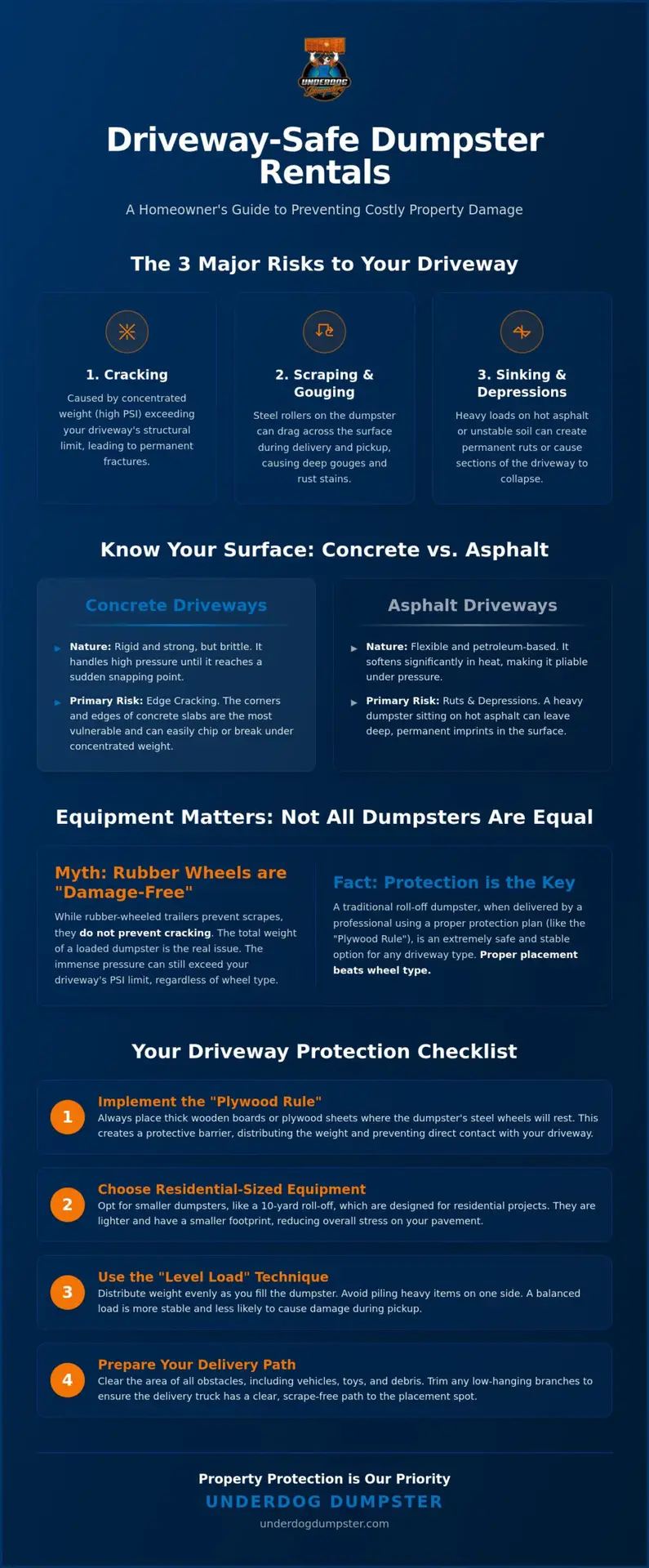
Damage typically occurs in three forms: cracking, scraping, or sinking. The primary culprit is often the Pounds per Square Inch (PSI) exerted on the surface. While a driveway might look solid, it has a clear breaking point. When the weight of a delivery truck and a loaded container exceeds the PSI capacity of the concrete or asphalt, the material fails. Roll-off dumpsters are efficient for waste removal, but their concentrated weight points can easily overwhelm residential subgrades. Choosing a local expert like Underdog Dumpster ensures you have a partner who understands these local variables and prioritizes your property's safety.
Concrete vs. Asphalt: Different Surfaces, Different Risks
Concrete is a rigid material. It handles high pressure well until it reaches a snapping point. This often leads to "edge cracking" where the slab is most vulnerable. Asphalt behaves differently. It's a flexible, petroleum-based surface that reacts to the environment. During a Clarksville summer, the heat softens asphalt significantly. A heavy bin sitting on hot asphalt can create deep ruts or permanent depressions. You also have to consider what's happening underground. Local soil erosion can create hidden hollow spots beneath your driveway. A heavy delivery can cause these spots to collapse, leading to immediate sinking and expensive repairs.
The Friction Factor: Scrapes and Gouges
Steel rollers and pavement are a bad combination. During the unloading process, the "drop and drag" effect is a major risk factor. As the bin slides off the truck, the metal wheels can gouge decorative or stamped concrete. If the rental equipment is poorly maintained or rusted, the damage is even worse. Rust can transfer to your driveway, leaving stains that are nearly impossible to remove without professional pressure washing. To ensure a truly driveway safe dumpster rental, you need equipment that is well-maintained and a driver who uses precision during the placement process. Protecting your investment starts with recognizing these mechanical risks before the truck ever pulls into your neighborhood.
Equipment Options: Roll-Offs vs. Dump Trailers
Choosing the right equipment is the first step toward a damage-free project. Homeowners often choose between two main styles: traditional roll-off containers and rubber-wheeled dump trailers. Each has a different footprint and impact on your property. Roll-off bins provide a sturdy, fixed-location solution for large cleanouts. Dump trailers offer mobility but require more vertical and horizontal clearance for the towing vehicle. In Clarksville's tight residential streets, the ability to maneuver into a narrow driveway without jumping the curb is essential.
Maneuverability depends on the total length of the delivery vehicle. A standard truck carrying a roll-off is often more compact than a truck towing a long trailer. While trailers can be moved around your property, they often have a larger footprint once you account for the hitch and tongue. If your project requires the bin to stay in one spot for a week, a roll-off is typically the most stable choice. Regardless of the style, scientific studies on pavement damage from heavy vehicles show that total weight is the primary factor in structural failure. You must balance the convenience of the equipment with the physical limits of your driveway.
The Truth About Rubber Wheels
Many providers market rubber-wheeled trailers as the only safe option for residential use. It's true that rubber tires reduce surface friction and prevent the scrapes associated with steel rollers. However, they don't eliminate the risk of cracking. If a trailer is overloaded, the pressure can still exceed your driveway's PSI limit. Rubber tires distribute weight across a wider surface area than steel rollers, yet the total downward force remains constant regardless of the wheel material. Don't assume a trailer is "safe" just because it has tires. You still need to monitor the total weight you're loading into the container.
Traditional Roll-Offs with Protection
A 10-yard roll-off is often the "sweet spot" for residential safety. It's large enough for most basement or garage cleanouts but compact enough to fit on a single parking pad. You can make any roll-off a driveway safe dumpster rental by using professional dunnage. This involves placing heavy-duty wooden boards under the contact points to spread the load and prevent steel-on-concrete contact. This method is a standard industry practice that protects even the most delicate surfaces. If you're unsure which equipment fits your specific layout, reach out to our team for a quick property assessment. We specialize in residential sizing that prioritizes your pavement's integrity.
The Ultimate Driveway Protection Checklist
Preparation is the final piece of the puzzle. Even the best equipment can cause issues if the site isn't ready. You need a proactive strategy to guarantee a driveway safe dumpster rental experience. This checklist focuses on the physical environment of your property, ensuring the delivery truck and the container have a clear, reinforced space to operate. Follow these steps to minimize risk before the truck arrives at your curb.
- Clear the Path: Remove all low-hanging branches and check for overhead wires. Most delivery trucks require at least 14 feet of vertical clearance just to drive, and significantly more to drop the bin.
- Identify Underground Hazards: Never place a dumpster over a septic tank, leach field, or known utility lines. Mark these areas clearly with flags or bright tape so the driver knows exactly where to avoid.
- Measure the Swing Zone: A roll-off truck needs space to tilt its bed and slide the container off. Ensure you have at least 60 feet of straight-line distance to accommodate the truck and the bin during the unloading process.
- Check the Calendar: Monitor the Clarksville weather forecast. Saturated soil is much more likely to shift or sink under heavy loads, so try to avoid deliveries during high-moisture windows.
Setting Up Your Surface Protection
The "Plywood Rule" is your best defense against surface damage. Use 3/4-inch plywood sheets to create a buffer. Lay them where the bin will sit, overlapping the edges by at least six inches to create a continuous, reinforced platform. For traditional roll-offs, place 2x10 wood planks exactly where the steel rollers will land. This prevents the metal from ever touching your pavement. Don't forget the driveway entrance. Laying a sheet of plywood at the curb helps protect the edge of your driveway from the heavy impact of the truck's tires as it makes the initial turn into your property.
Clarksville-Specific Environmental Considerations
Local conditions play a massive role in property safety. If you live in the Sango area, you likely deal with steep inclines. Never attempt a delivery on a steep slope without consulting Underdog Dumpster first; gravity can cause the bin to slide even after it is placed. Temperature matters too. On 90-degree Clarksville days, asphalt becomes pliable. If your driveway is in direct sun, cool it down with a garden hose before the truck arrives to help the surface maintain its hardness. If it rained heavily in the last 24 hours, consider rescheduling. Soft soil around the edges of a driveway is the leading cause of "sideways sinking" where the bin tilts and cracks the pavement edge.
Weight Management and Loading Strategies
A common homeowner objection is that a full dumpster is simply too heavy for residential concrete. While it's true that weight causes stress, the way you load the container determines how that stress is distributed. A driveway safe dumpster rental depends on your ability to manage the center of gravity. If you stack all the heavy debris on one side, you create a pressure point that even the best surface protection can't fully counteract. Managing weight is a shared responsibility between the rental provider and the user.
The "Level Load" rule is a safety requirement for a reason. Keeping debris below the rim ensures the weight stays centered during pickup. When the truck lifts the container, an uneven load can shift violently. This creates a sudden spike in downward force on your driveway's edge, which often leads to the cracking risks we identified earlier. You should also watch out for heavy materials like concrete, dirt, and brick. These items are incredibly dense. Filling a standard bin with masonry debris can easily exceed weight limits and create dangerous pressure levels. If you're doing a masonry project, always ask for specialized containers designed for heavy fill.
Rainwater is a hidden weight factor that many homeowners overlook. Porous debris like old carpet, drywall, and wood absorbs water during a storm. A single heavy Clarksville rain can add hundreds of pounds to your total load. This extra weight increases the PSI on your driveway surface. If you expect a storm, consider covering the bin with a tarp to keep the weight predictable and prevent unnecessary pressure on your pavement.
How to Load for Maximum Stability
Always place the heaviest items at the bottom and center of the bin. This anchors the container and prevents it from shifting during the project. Distribute your weight evenly from front to back to keep the container level during the final haul-away. Concentrating weight on one side or end can cause the dumpster to tip or slide during the loading process, potentially gouging your driveway surface. Use smaller items to fill the gaps around large furniture to keep the load compact and stable.
Estimating Your Debris Weight
Choosing the right size initially is the best way to avoid overweight fees and excessive surface pressure. Standard household furniture and general clutter weigh significantly less than construction debris or roofing shingles. For a detailed breakdown of how to match your project to the right bin, check our Residential Dumpster Rental in Clarksville guide. If you're still unsure about the total weight of your debris, talk to our local experts to get a professional estimate before you book.
Why Underdog Dumpster is Clarksville’s Driveway-Safe Choice
Choosing a local provider makes a significant difference in your property's safety. National brokers often farm out jobs to the lowest bidder, leaving you with a driver who doesn't know the local terrain. We live and work in Montgomery County. Our drivers understand the specific challenges of Clarksville's streets, from the steep hills in Sango to the narrow residential lanes near downtown. This local expertise allows us to navigate your property with precision and care that a distant call center simply can't match.
We specialize in residential service by focusing on 10 and 15-yard roll-off containers. While we offer larger 20 and 25-yard options for major construction, our smaller bins are the primary choice for homeowners. These sizes provide a compact footprint that fits comfortably on a standard parking pad or driveway. This reduces the total weight load on your pavement and ensures a driveway safe dumpster rental experience from start to finish. We don't just deliver a box; we deliver a service tailored to the physical limits of residential properties.
Efficiency is at the core of our business model. We've embraced modern digital tools to make the process as painless as possible for our neighbors. Our online booking system allows you to select your size, choose your dates, and secure your rental in minutes. We use a transparent, flat-rate pricing model. You'll know exactly what you're paying upfront, including the delivery and pickup. There are no hidden fees or "broker markups" to worry about. We prioritize straightforward communication and reliable performance over flashy marketing gimmicks.
Professional Delivery with a Personal Touch
Our commitment to property respect is what sets us apart. We don't just drop the bin and drive away. Our drivers work directly with you to ensure your protection measures, like the plywood and planks we discussed earlier, are perfectly positioned. We take the time to align the rollers with your dunnage to prevent any metal-on-surface contact. Neighbors across Clarksville trust us because we treat every driveway as if it were our own. We've built our reputation on showing up on time and leaving your property exactly how we found it, minus the junk.
Ready to Book Your Driveway-Safe Rental?
Don't risk your property by booking through a national broker who doesn't know the difference between Tiny Town Road and Madison Street. Work with a local team that prioritizes your driveway's integrity. We offer fast delivery options throughout Sango and the greater Clarksville area to keep your project moving. Our process is designed to be rapid, methodical, and completely transparent. Protect your investment and get your cleanup started today. Book Your Driveway Safe Dumpster Online Now and experience the difference of a professional, local partner.
Start Your Cleanup with Total Confidence
You now have the professional tools to prevent property damage before your project begins. Protecting your driveway requires a proactive mix of site preparation and selecting the right local partner. By using surface barriers like plywood and managing your load weight, you effectively eliminate the risks of cracks, ruts, and gouges. Achieving a driveway safe dumpster rental doesn't have to be a source of stress when you follow a clear protection plan.
Underdog Dumpster is locally owned and operated right here in Clarksville. We specialize in residential-friendly 10-yard containers that fit perfectly on your property without overwhelming the pavement. Our flat-rate pricing ensures you get transparent costs with no hidden damage fees or broker markups. We're ready to help you tackle your next home project with the efficiency and care your property deserves.
Rent Your Driveway-Safe Dumpster in Clarksville Today. Your home is your biggest investment; let's keep it protected while you clear the clutter.
Frequently Asked Questions
Will a dumpster crack my concrete driveway?
A dumpster can crack concrete if the total weight exceeds the slab's PSI capacity or if it sits over a hollow spot. Edge cracking is the most common issue when heavy rollers rest too close to the side of the driveway. You can prevent this by distributing weight evenly and avoiding overfilled containers that exceed residential weight limits.
Do I need to put wood under the dumpster?
Placing wood under the contact points is the most effective way to ensure a driveway safe dumpster rental. Use 3/4-inch plywood sheets or heavy-duty 2x10 wood planks to spread the load across a wider surface area. This prevents steel rollers from gouging the pavement and helps protect decorative or stamped concrete from permanent damage.
Can I put a dumpster on my lawn if the driveway is too small?
Lawn placement is risky and usually results in deep ruts or damage to underground sprinkler lines. Most delivery trucks weigh several tons and will sink into soft turf immediately. If your driveway is too small, check with the City of Clarksville about a permit for street placement instead of risking your landscaping.
How much space do I need for a 10-yard dumpster delivery?
You need approximately 60 feet of straight-line clearance for a 10-yard dumpster delivery. This provides enough room for the truck to back in and tilt the bed to slide the container into place. Ensure you also have at least 14 feet of vertical clearance to avoid low-hanging branches or power lines during the drop-off.
What happens if it rains while the dumpster is in my driveway?
Rainwater makes porous debris like wood, carpet, and drywall much heavier, which increases the pressure on your driveway surface. A single heavy storm can add significant weight to your total load. Cover your bin with a tarp during wet weather to keep the weight predictable and avoid potential overweight fees during pickup.
Is a dump trailer safer than a roll-off dumpster?
Dump trailers use rubber tires to prevent surface scrapes, but they don't eliminate the risk of weight-related cracks. A traditional roll-off dumpster is just as safe when you use proper wood dunnage as a barrier. Total weight remains the primary factor in pavement damage, regardless of whether the bin has wheels or steel rollers.
Do I need a permit to put a dumpster in my driveway in Clarksville?
You don't need a permit to place a dumpster on a private residential driveway in Clarksville. Permits are generally only required if the container will sit on public property, such as a city street or sidewalk. Always verify current local regulations with the City of Clarksville if you plan on any placement outside your property line.
What should I do if the dumpster starts to sink?
Stop loading the bin immediately if you notice it starting to sink or tilt into the ground. Contact your rental provider right away to discuss an early pickup or a relocation strategy. Don't attempt to move a sinking dumpster yourself, as this can cause severe damage to your driveway and the delivery vehicle.